CounterStack Hold’em
Hold’em played with five forces — no high suit, no low one.
The game
Hold'em played with five forces instead of four suits. Two cards each, a three-card flop, a turn and a river, and the best five of your seven takes it — the shape every card player already knows. What changes is what a card is. Rock, Paper, Scissors, Lizard and Savant each beat two of the others and lose to the other two, so there is no high suit and no low one, and no card is ever simply better than another card.
That single change rewrites the hand table. Five Forces — one of every force — sits at the top at 1 in 10,089. Under it is the hand the game is named for: the Battle Cycle, five ranks in a row where every card defeats the next and the last loops back to the first. A run that does not close the loop is only a Rank Run, near the bottom of the table. The same five cards can be a one-in-3,492 hand or a one-in-twelve hand depending on nothing but which forces they happen to be.
And the forces settle ties. Two players with the same hand and the same ranks do not go to a kicker — the battle decides it, on the forces of the cards that made the hand. Only when those are genuinely level does the pot split.
Worth a closer look
A shared deck, and nothing else shared. Hold'em uses the same fifty cards as CounterStack and is a completely different game: that one is solitaire against a verified-winnable deal, this one is no-limit betting against two to four people at a table. If you know one, you know the deck. You do not know the game.
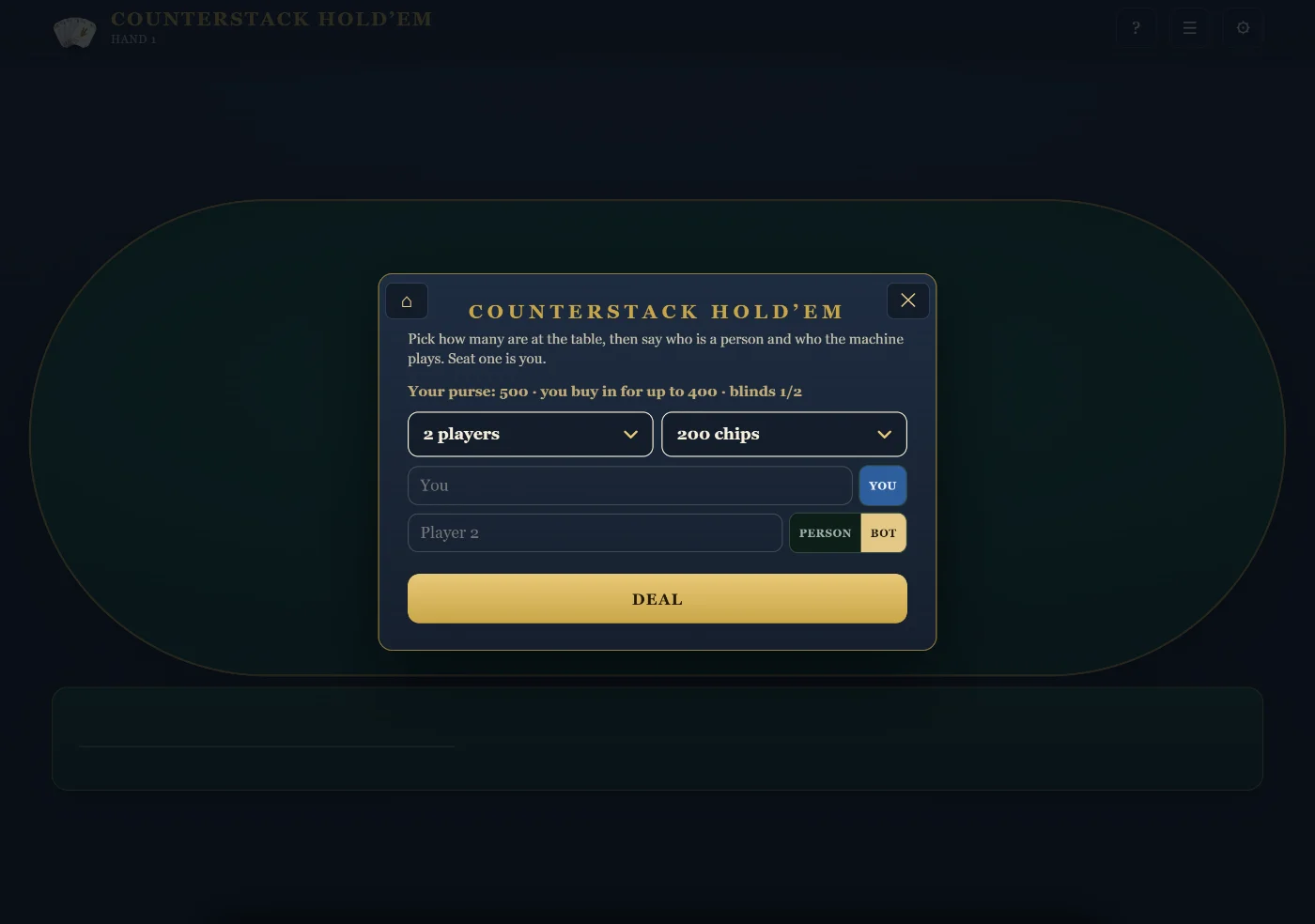
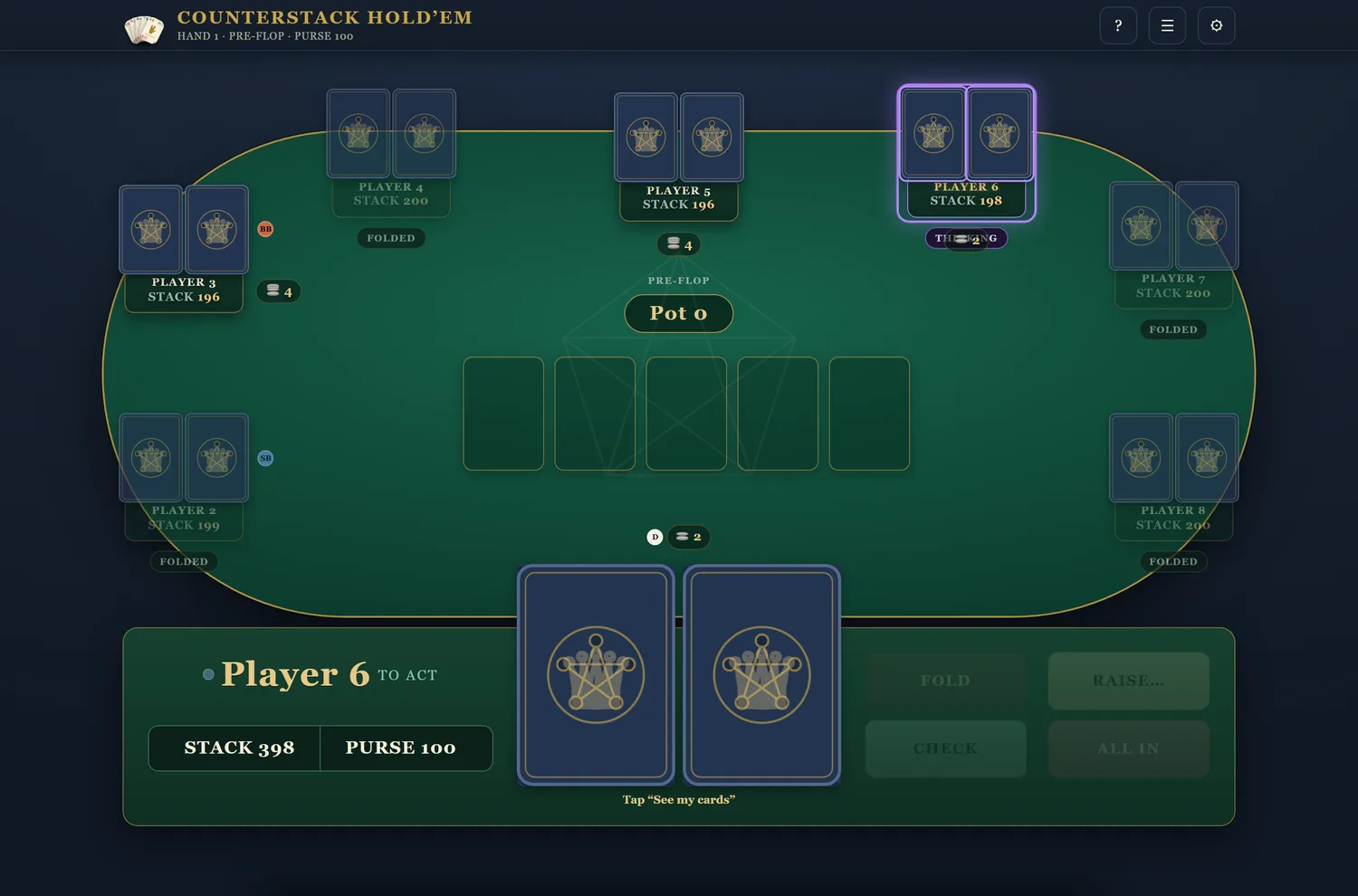
Every seat is yours to fill. Two to four players on one device, and each seat is set to a person or the machine before the deal. Pass the phone round, or play the table alone against three opponents.
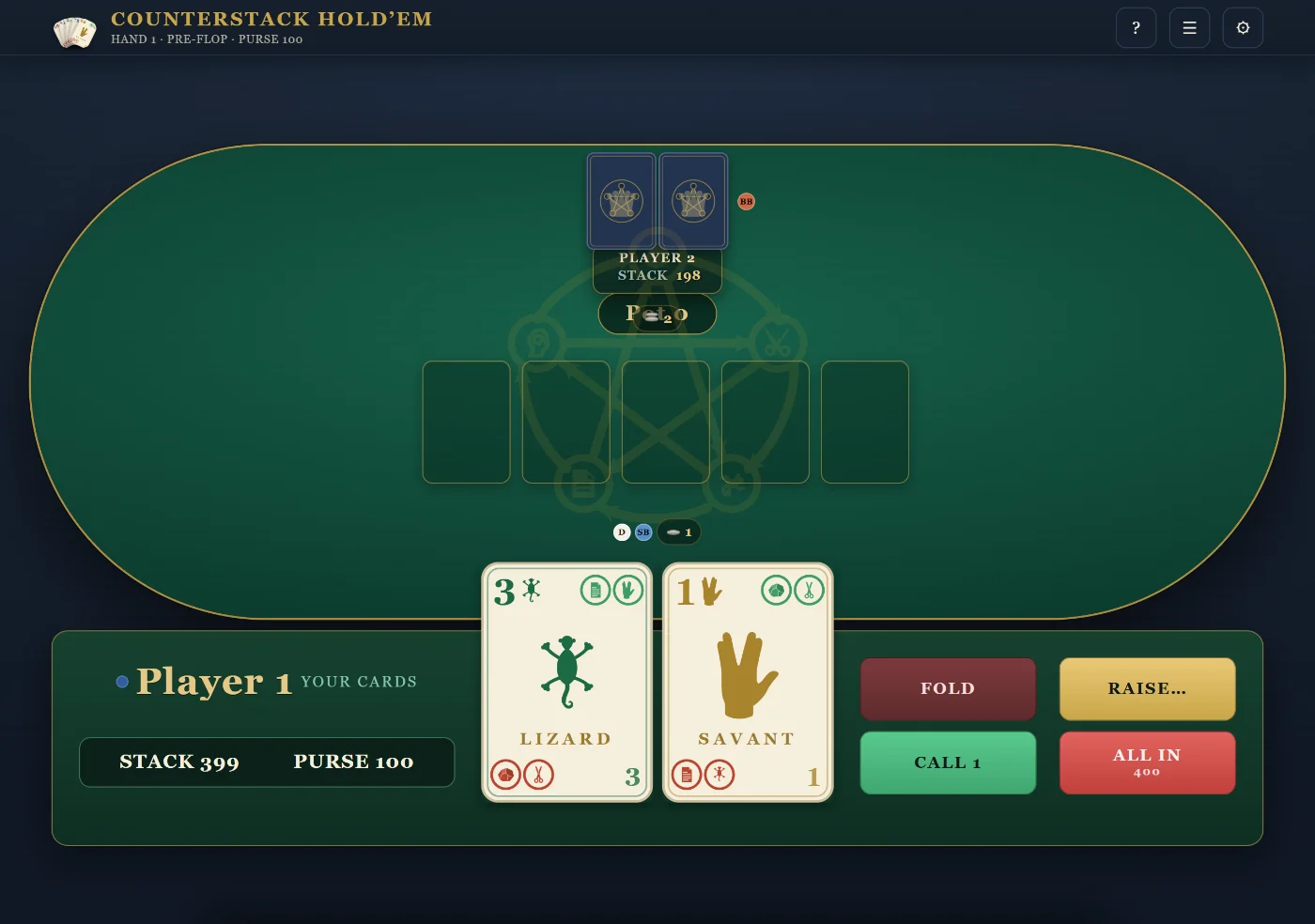
Every card shows its own battle. A card's face carries the two forces it beats and the two that beat it, so you never have to hold the ten-way relationship in your head to read your own hand.
How it plays
- Take your seats. Two to four at the table, each one a person or the machine. Your purse is 500, you buy in for up to 400, blinds are 1 / 2.
- Two cards each. Then a three-card flop, a turn and a river, betting between each. Make the best five of your seven.
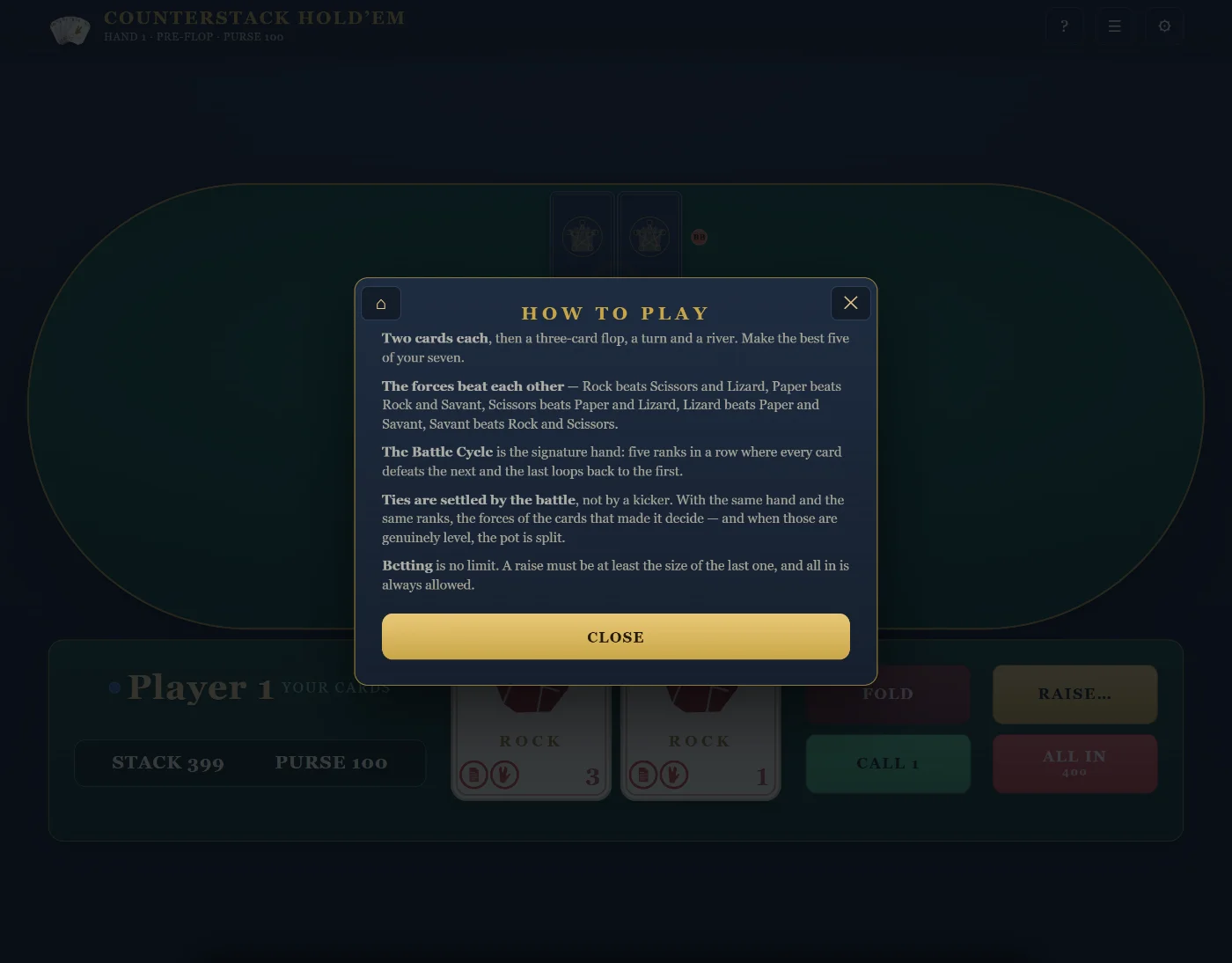
- Know what beats what. Rock beats Scissors and Lizard. Paper beats Rock and Savant. Scissors beats Paper and Lizard. Lizard beats Paper and Savant. Savant beats Rock and Scissors. Every card face carries its own two-and-two.
- Bet with no limit. A raise must be at least the size of the last one, and all in is always allowed.
- Win the tie in the battle. Same hand, same ranks? The forces of the cards that made it decide — not a kicker. Genuinely level splits the pot.
The hands, best first
Ten categories, and the odds are the game's own:
- Five Forces — one of every force. 1 in 10,089
- Battle Cycle — five ranks in a row, each defeating the next, the last looping back to the first. 1 in 3,492
- Pure Force Run — a run all in one force. 1 in 3,492
- Four Stack — four of a rank. 1 in 141
- Force Flush — five of one force. 1 in 100
- Full Stack — three of a rank and a pair. 1 in 15
- Triple — three of a rank. 1 in 13
- Rank Run — five ranks in a row that do not close the loop. 1 in 12
- Pair — one pair, or two. 1 in 3
- High Rank — everything else. the floor
Note where the two runs sit. A five-rank straight is common — one in twelve — and worth almost nothing. The same five ranks whose forces close the battle loop is a Battle Cycle, nearly three hundred times rarer, and beats everything but Five Forces.