ShiftRummy
Slide the deck. Build the run.
Two games, one deal
The day's deal is played two ways, the shape LexiMaze already uses. Rummy is the score attack: bank as many melds as forty shifts will buy, and banked cards lock where they are.
Maze carves the same deal into a maze. One route joins the corner to the way out, six coloured gates stand along it, and each opens only for a particular kind of meld — any meld, then a set of three, a run of four, a meld across a ★ or a gold square, a set of thirty or more, and last a meld worth sixty or more. You need not take them in order — build a meld anywhere and it opens the earliest shut gate it satisfies — but the route decides which one is standing in your way. Walking the corridors costs nothing; the shifts are what you spend building the key a gate is asking for.
The two modes want opposite things from the same forty-shift habit. Rummy hands you a budget and pays for what you bring home unspent. The Maze has no cap at all — shift as much as you like — and grades you on how few you needed, fifteen points a shift off a six-hundred-point start. One is thrift, the other is a clean line.
The game
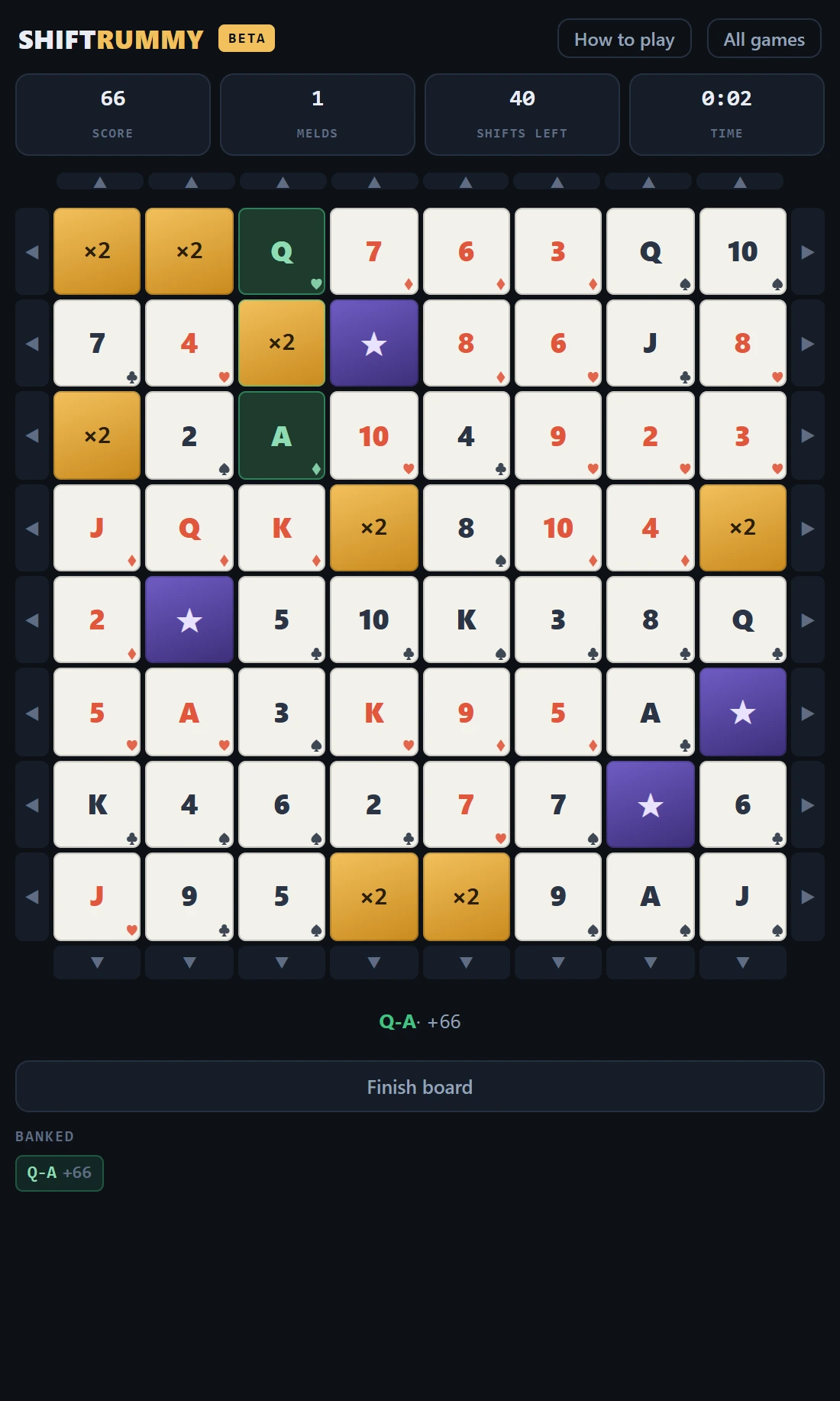
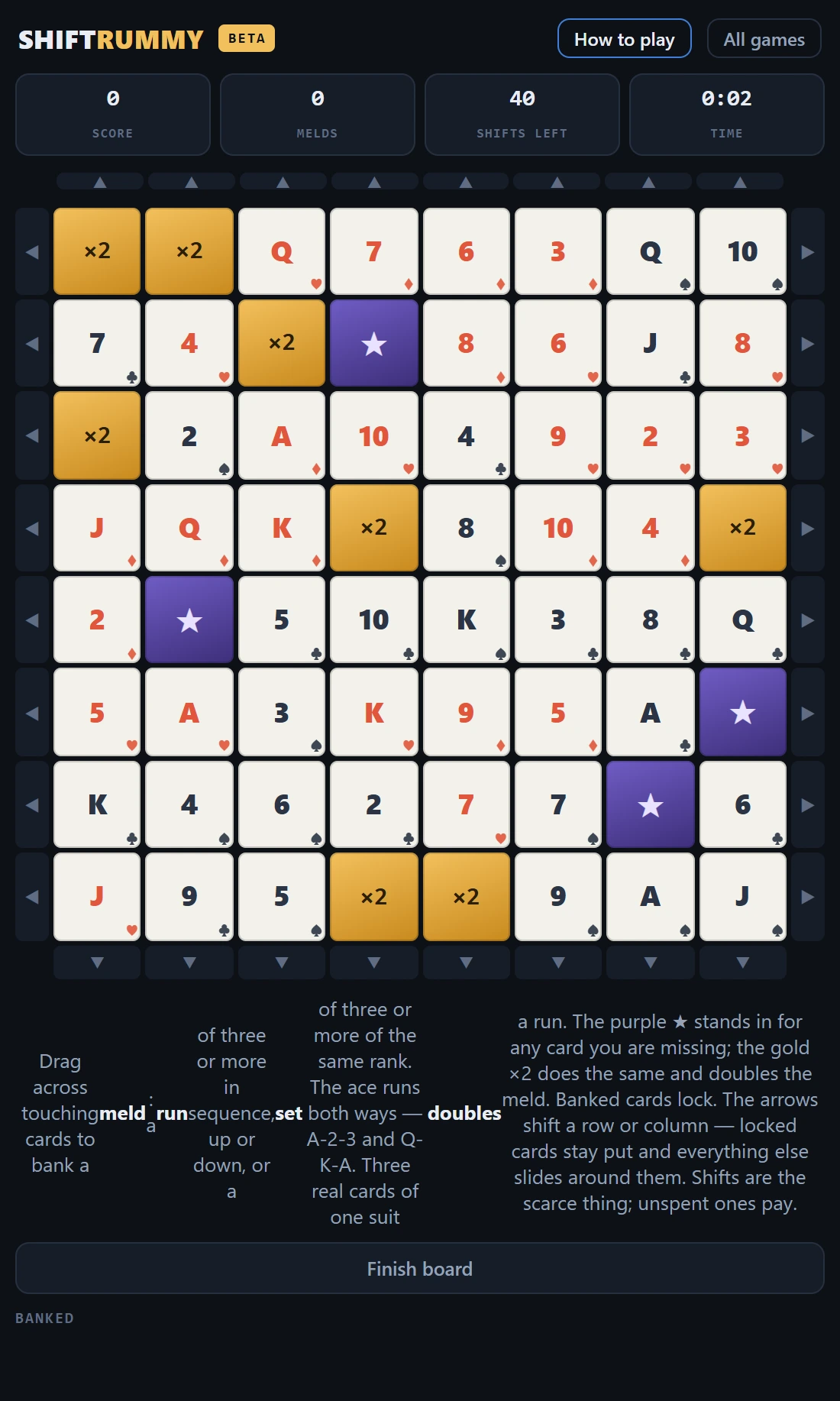
A full deck dealt into a board you can rearrange, plus twelve squares that are not cards. Every one of the fifty-two is on the board, exactly once, so a card you are looking for is always somewhere. Trace a line across adjoining cards and it banks if it is a run — three or more consecutive ranks, up or down — or a set, three or more of the same rank. Three of a suit in a run doubles it, and the ace plays both ends, so 10-J-Q-K-A of one suit is exactly the hand it looks like.
Finding a meld is the easy part; the board shows you everything it has. The question is whether you can afford to assemble one. The arrows down each side slide a whole row or column, and you have forty shifts for the board — so every meld costs something, and the ones you leave alone are worth as much as the ones you take.
Banked cards lock where they are. A shift slides everything still loose around them, which means the board gets more rigid with every meld you bank. The opening is roomy and the endgame is a vice, and you did that to yourself.
Worth a closer look
Unspent shifts pay. Eight points each at the finish, so a board cleared with fifteen left beats the same board wrung dry. That turns the budget from a limit into a currency, and it is the difference between "how many melds can I make" and "which melds are worth making".
Twelve squares are not cards. All twelve work the same way: you trace straight through them and they stand in for whatever card the meld is missing. A purple ★ just fills the gap; a gold square fills it and multiplies the meld — and they are not all alike, six being ×2 and two ×3. So 8-★-10 banks as the run 8-9-10, and 8-×3-10 banks as the same run for three times the score; cross two gold squares and the multipliers stack. None of them can start or finish a meld, so they close gaps rather than inventing melds out of nothing. One of the Maze's gates opens only for a meld routed across one.
It needs no English. Six of the games here validate against a 179,000-word English dictionary and cannot be scored by someone who does not read it. This one is a deck: ranks and suits, understood everywhere. It shares an engine with LexiMaze and none of its vocabulary.
A run is ranks, a flush is a bonus. The first version demanded both at once, and three adjoining cards that are same-suit and in sequence almost never occur on a fresh deal — the board opened with nothing to do. Splitting them gives you a move on turn one and keeps the suit as the thing worth spending shifts to reach.
How it plays
- Find three that go together. Consecutive ranks — 4-5-6, or J-Q-K, counting either direction — or three of a kind. Suits do not matter yet. The ace runs low in A-2-3 and high in Q-K-A; it will not do both at once, so K-A-2 is not a run.
- Get them touching. The arrows around the board slide a row or a column one step. Cards you have already banked do not move; everything else slides around them and wraps.
- Trace it. Drag across the cards in order, one step at a time, up down left or right. Drag back over the last one to rub it out.
- Use the twelve. A purple ★ fills whatever card the meld is missing; a gold square does the same and multiplies what the meld scores — six of them ×2, two of them ×3. Neither can be the first or last card in it.
- Spend shifts like money. Forty a board, and every one you do not spend is eight points at the finish.
- Undo takes it back. A shift moves eight cards at once and a banked meld locks where it sits, so a misdrag used to cost you something real. Undo steps back as far as you like, all the way to the deal — the button, Ctrl+Z, or just U.
The board ends when the shifts are gone and no meld can be traced on what is left. It works that out itself rather than leaving you to prove it.
Scoring
- Sum of the ranks. King is 13, a wild or bonus square counts 7, and the ace is worth 1 at the bottom of a run or 14 at the top — which is most of the reason to reach for the top.
- Length multiplies — 1.5× at four cards, 2× at five, 3× at six.
- Three real cards of one suit doubles whatever the length multiplier produced. Two cards and two wilds is not a flush.
- Each gold square multiplies the meld again for routing it across one — ×2 or ×3, and they stack.
- Eight a shift for everything you did not spend.