RoyalDoku
Chess-piece deduction — guess-free by construction

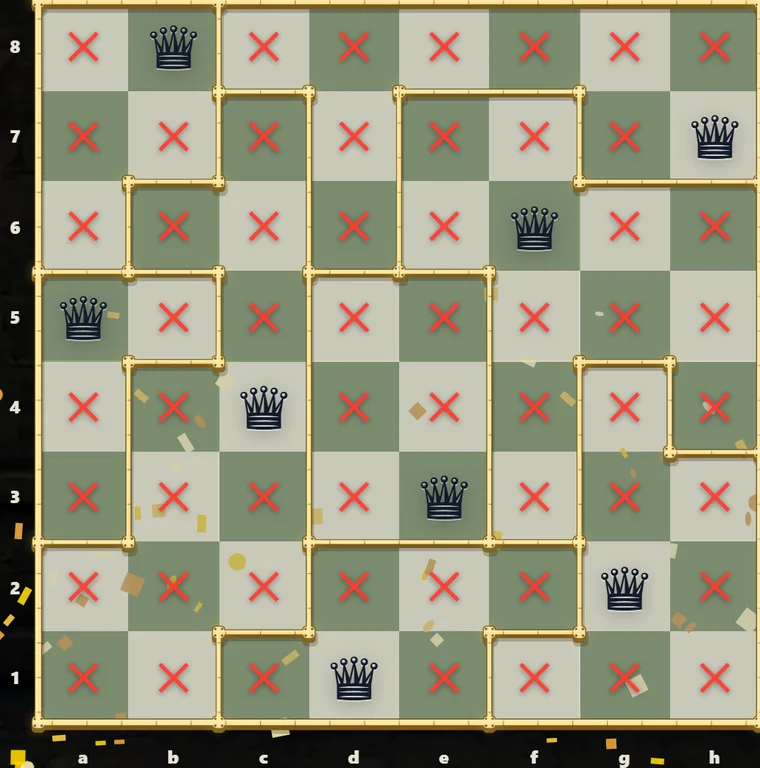
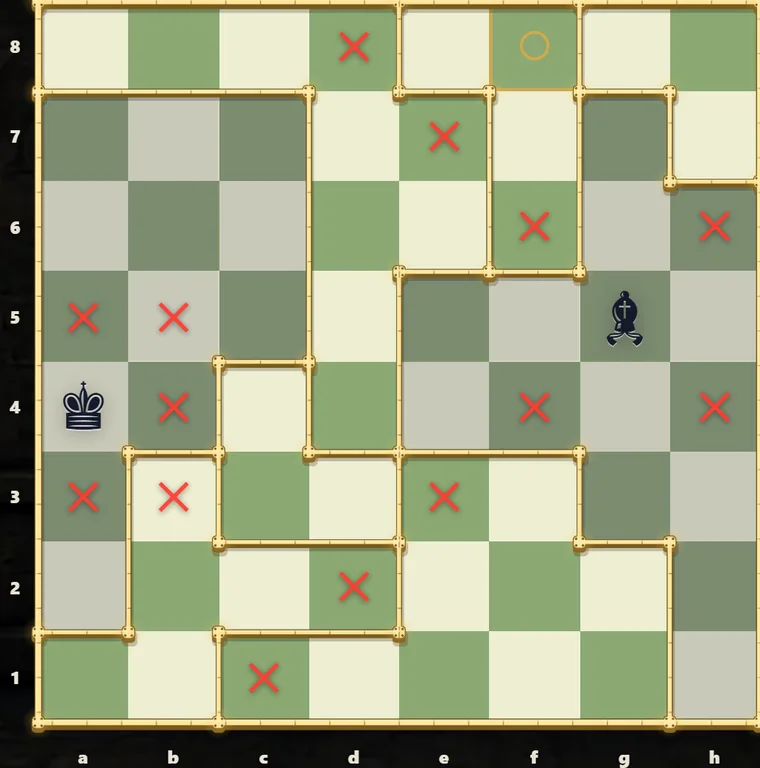
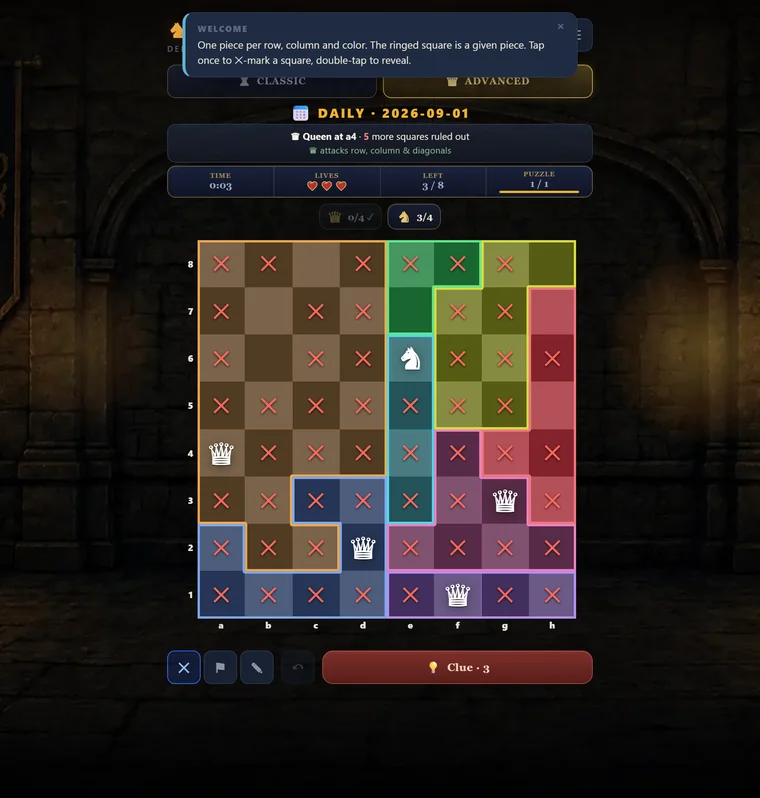
The game
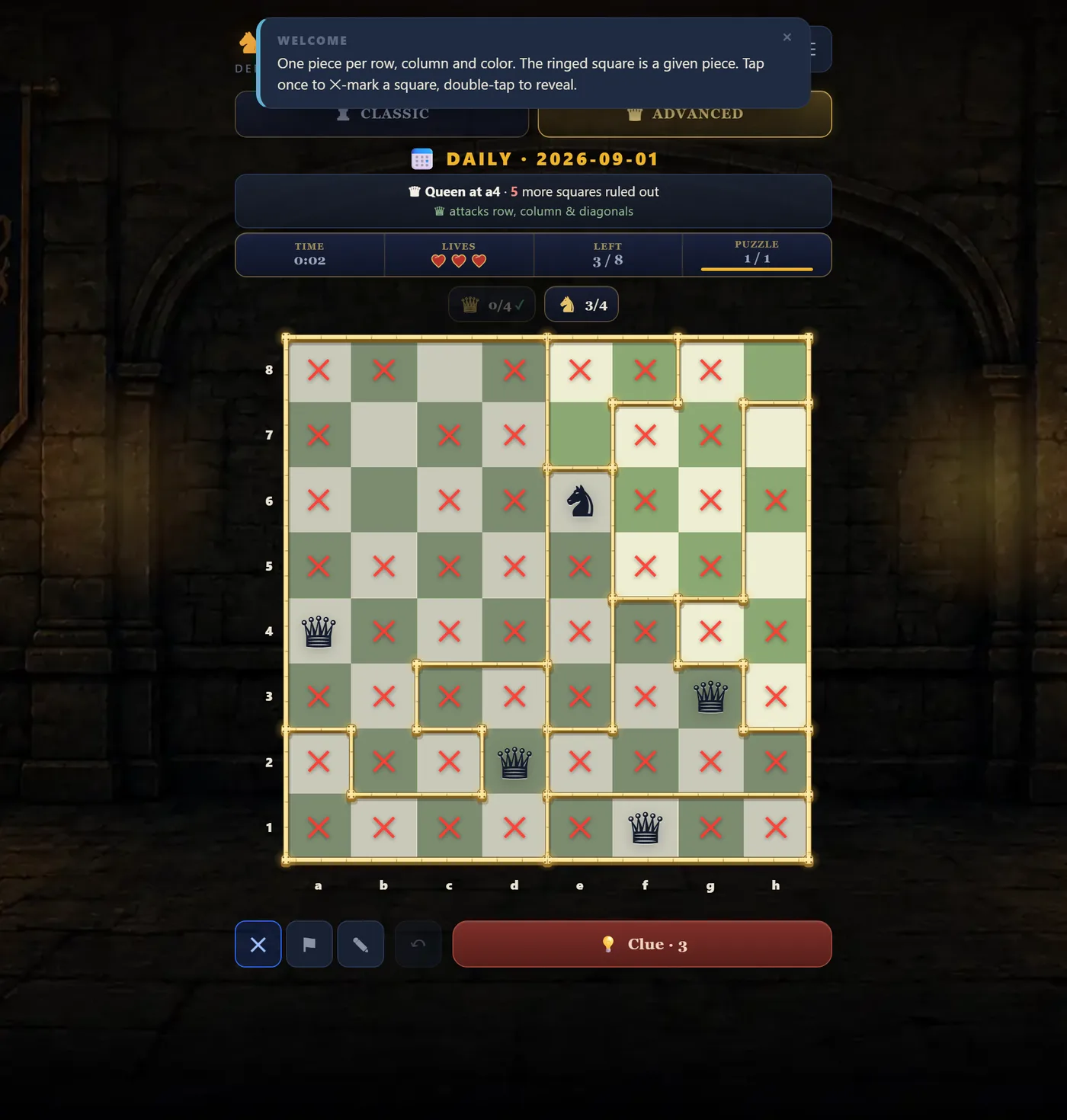
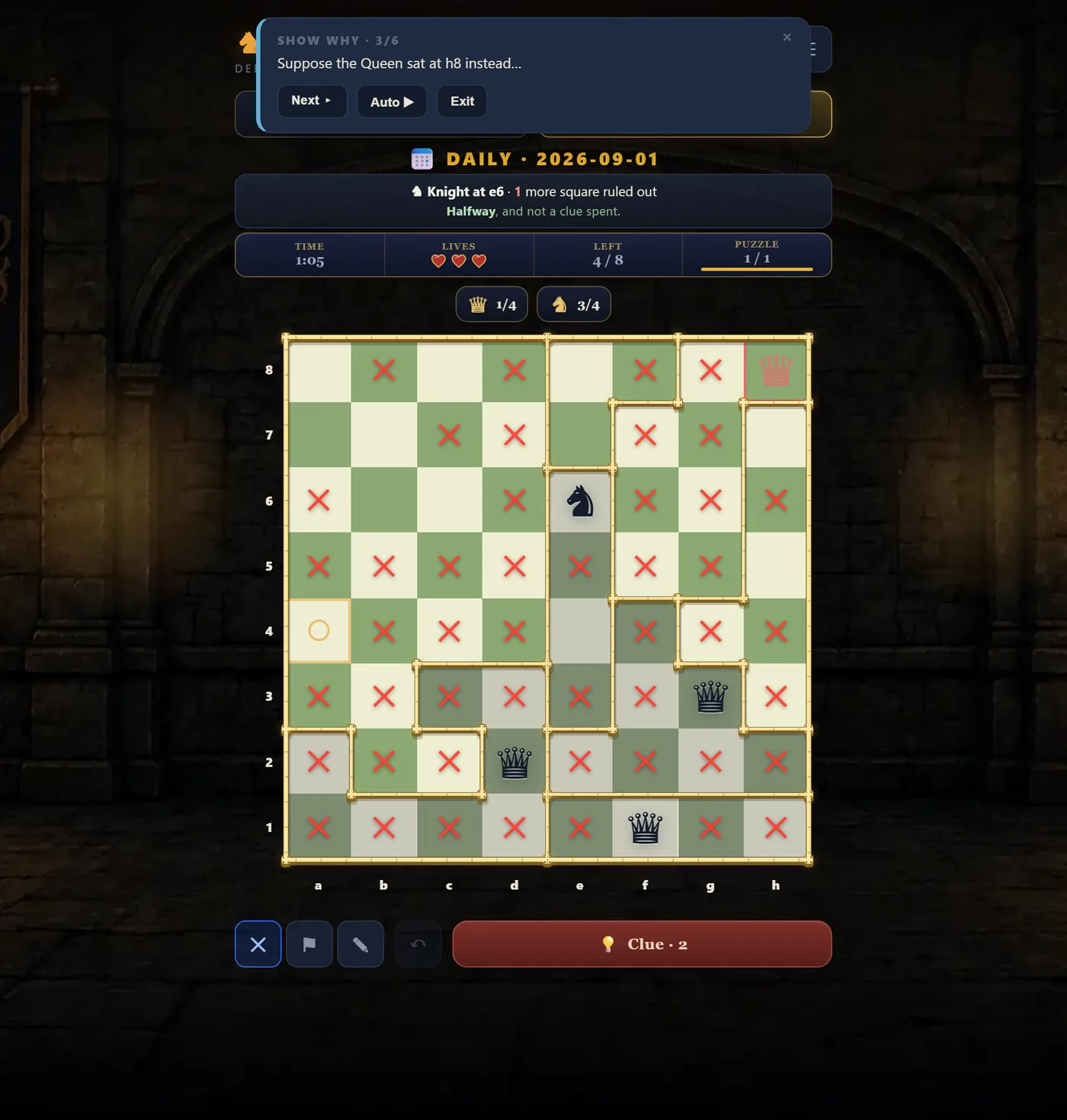
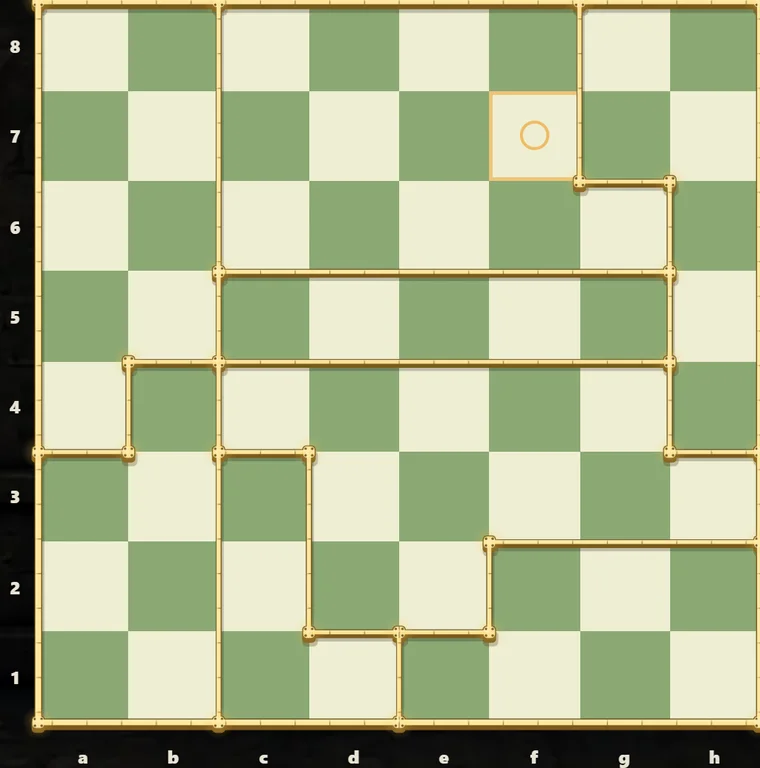
A hidden court of chess pieces sits on the board: one piece per colour region, and — because they are chess pieces — no piece may attack another. Classic lays Sudoku's lines on top of that, one piece per row and column; Advanced takes them away and leaves reach as the only law. You rule squares out, pencil in suspects, and reveal the court by pure logic.
Guess-free is not a slogan, it is a construction constraint. Every deal is generated offline and machine-verified to have exactly one solution — then checked again by a logical solver that must reach that solution using deduction steps a human can make. If a board would ever reduce you to guessing, it does not ship.
Worth a closer look
- The no-guess guarantee is auditable: deals come from an offline generator that counts solutions and replays the actual rules — not from a difficulty heuristic.
- Castle walls view: an optional 3D-walled board where the masonry itself is the region map — the information load drops, and the board becomes a place.
- A deduction vocabulary, not just an eraser: eliminations, flags, per-piece marks and soft what-if marks each claim something different.
How it plays
- Tap a square to rule it out; double-tap to reveal when you are certain. A wrong reveal costs a heart and a time penalty — certainty is the currency.
- Pencil marks note which piece types could stand on a square — five types, five fixed positions, so a glance reads the possibilities. Flags watch squares you are reasoning about.
- The census under the board counts what remains of each piece type — a real given that real deductions hang on.
- Undo steps back marks only — it never un-reveals, never refunds. Knowledge is permanent.
Three rulesets — three ways of thinking
Classic is Sudoku law plus chess law. One piece per row, one per column, one per region — the lines do the heavy lifting, exactly as they do in Sudoku: a placed piece instantly sweeps its whole row and column, and you scan lines the way a Sudoku player scans boxes. The chess layer refines it — no piece may attack another — and the last few deductions are usually attack constraints closing what line logic alone cannot.
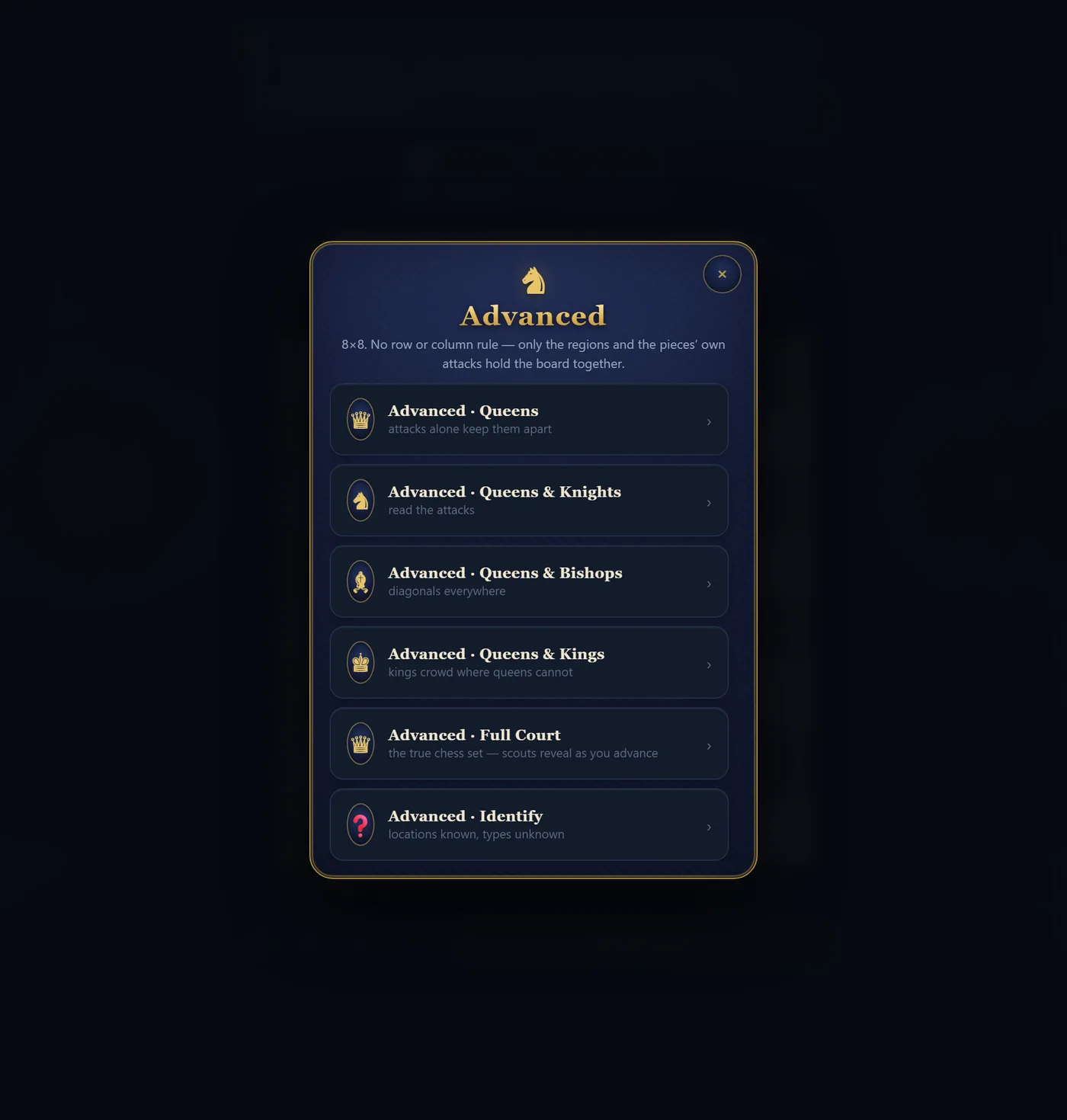
Advanced deletes the lines as law. Only two rules survive: one piece per region, and no piece attacks another. Nothing is universally forbidden any more — two knights may happily share a row — but nothing shares a line with a rook, because the rook attacks along it. The grid law you leaned on returns only where a piece’s own reach re-imposes it: a rook privately restores Sudoku on its lines, while a knight ignores lines entirely and forbids an L-shaped constellation instead. Constraint stops being a property of the grid and becomes a property of each piece.
Same board, same piece, opposite reasoning. Classic is bookkeeping: track the lines, refine with attacks. Advanced is coexistence geometry: every deduction flows from where power projects, so you think in shapes rather than rows — and the piece census becomes the spine of the solve. The ladder runs from kings-only up to a full mixed court, and the jump between rulesets is the game teaching you its second language.
Royal Chain is the third language, and it inverts the first two. Classic and Advanced both describe a court at peace: whatever else changes, no piece may attack another, and every deduction you make is about keeping power apart. Royal Chain asks for a court that is defended — every piece must guard exactly one other piece, no more and no less.
The whole board reads differently. A line of attack stops being the thing you eliminate and becomes the thing you are building; a piece with nothing to guard is now the contradiction, and so is a piece guarding two. Elimination still does the work, but you are eliminating arrangements that leave somebody unguarded rather than arrangements that leave somebody threatened. Players who find Advanced natural often find Chain the hardest turn in the game, because the instinct Advanced trains — keep them off each other — is exactly the instinct that has to go.
The daily
One global board a day — every player in the world gets the same deal, selected deterministically from the date, on a weekly rhythm: gentle Monday, advanced weekend. No account, no server round-trip, no way for two players to see different boards.
The ruleset is data
Under RoyalDoku sits a general deduction engine: a piece is a name, a glyph and an attack footprint, and the solver cascade — eliminations, census counting, uniqueness verification — never asks which game the footprint came from. Classic and Advanced are already two rulesets running on one engine. A set with entirely different movement — fantasy creatures, card suits, anything with a definable footprint — is a data file, not a rewrite, and the no-guess pipeline (generate, count solutions, replay the human-legal deductions) verifies it the same way.
What ships today is chess. What was built is a deduction platform.
The long form, with worked examples: the RoyalDoku guide.