LexiKaku
A hidden tiling. Each number is a word length.
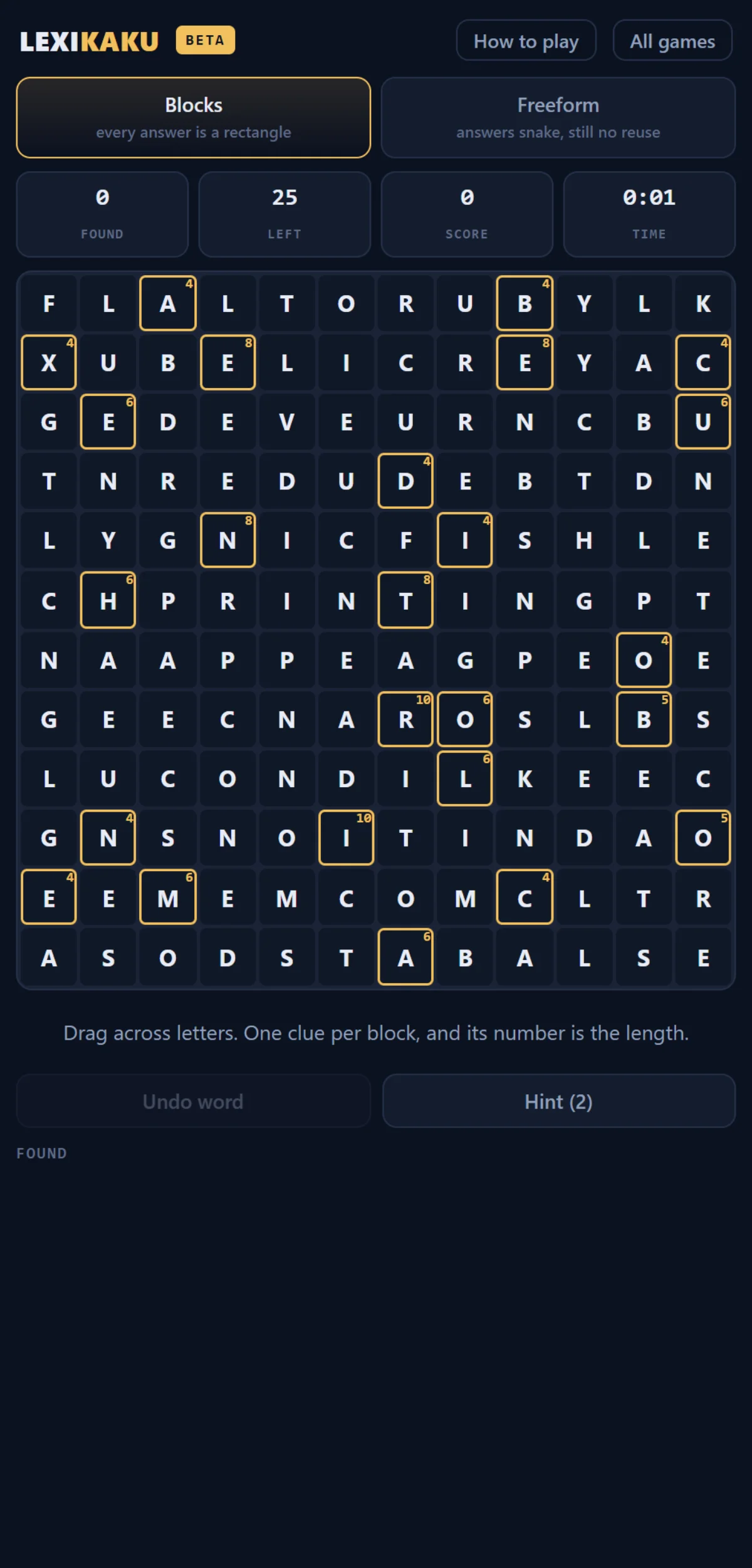
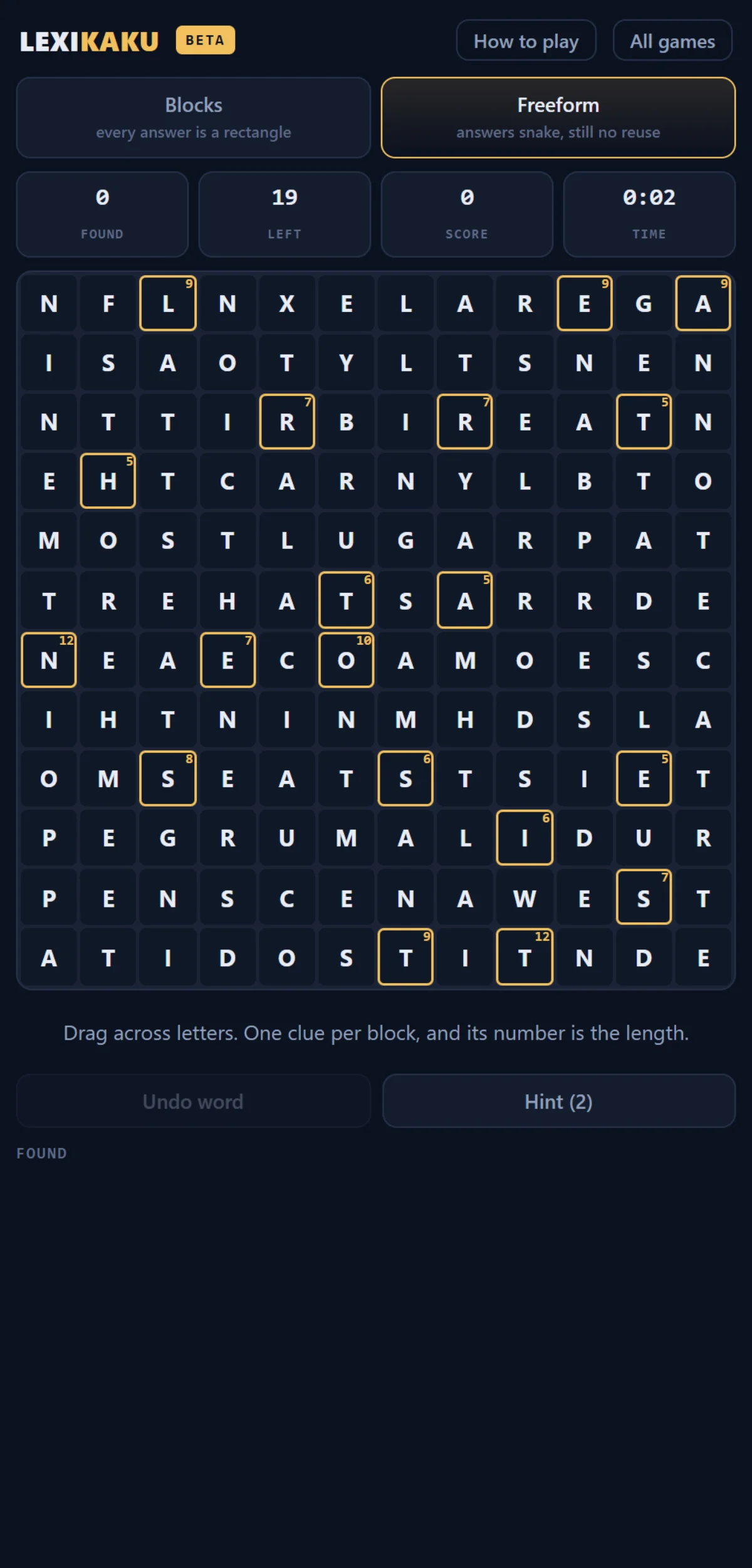
The game
Somewhere in a twelve-by-twelve grid of letters are the words. Nothing tells you where one ends and the next begins — except the numbers. Scattered through the grid are numbered letters, and each number says one thing: how many letters the block containing it takes.
So a 6 means there is a block of exactly six cells around it, and those six letters spell a word. Find the block and you have the word. It is Shikaku's idea — a number that tells you the size of the region it belongs to — with letters where the sums would be.
Every cell belongs to exactly one block, so the whole grid comes apart into words if you read it right. Claiming one block tells you something about its neighbours, which is the part that makes it a puzzle rather than a word search.
Worth a closer look
Two grids a day, and they are different games. In Blocks every answer is a filled rectangle, so the shape is half the deduction: a 12 is a 2×6, a 3×4, or a 1×12, and which one it is depends on what fits beside it. In Freeform the block may snake — L, S, whatever — as long as it never reuses a cell. Freeform has more shapes and therefore more candidates, which makes the numbers matter more, not less.
Words read either way round. The letters run along the path you draw, and the game checks it forwards and backwards, so a block you traced from the wrong end still counts. What it will not do is let you jump: the path is orthogonal, one step at a time.
Both dailies are ranked. Blocks and Freeform each carry their own leaderboard, and every run on them is replayed against the day's board before it counts — the board, the log and the result, re-derived from the rules rather than compared against a stored answer, so a different legal solution that scores the same still verifies. LexiKaku is not in the Gauntlet seven, so it cannot affect that day's run.
How it plays
- Find a number. Numbered letters are ringed. The number is how many cells the block containing it must have — not a score and not a difficulty.
- Draw the block. Drag from cell to cell, orthogonally, never reusing one. Drag back over the last cell to rub it out.
- Match the shape rule. In Blocks the cells must form a filled rectangle. In Freeform any snaking path will do.
- One number per block. Cover two and it is refused — each block answers to exactly one clue, and that is what makes the grid decomposable at all.
- Spell something. The letters along your path must be a word, read in either direction. Four letters minimum, and no word twice on the same grid.
Two hints a grid: one points at a clue still unsolved and tells you its size. It costs 25 points, which is less than it sounds and more than it looks.
Scoring
- Ten a letter. A six-letter block is 60.
- Twenty more for eight or longer, because the long ones are where the shape stops being obvious.
- Two hundred for a clean grid. Every cell claimed, every word found.
- Hints cost 25. Undoing a word takes its points back with it.